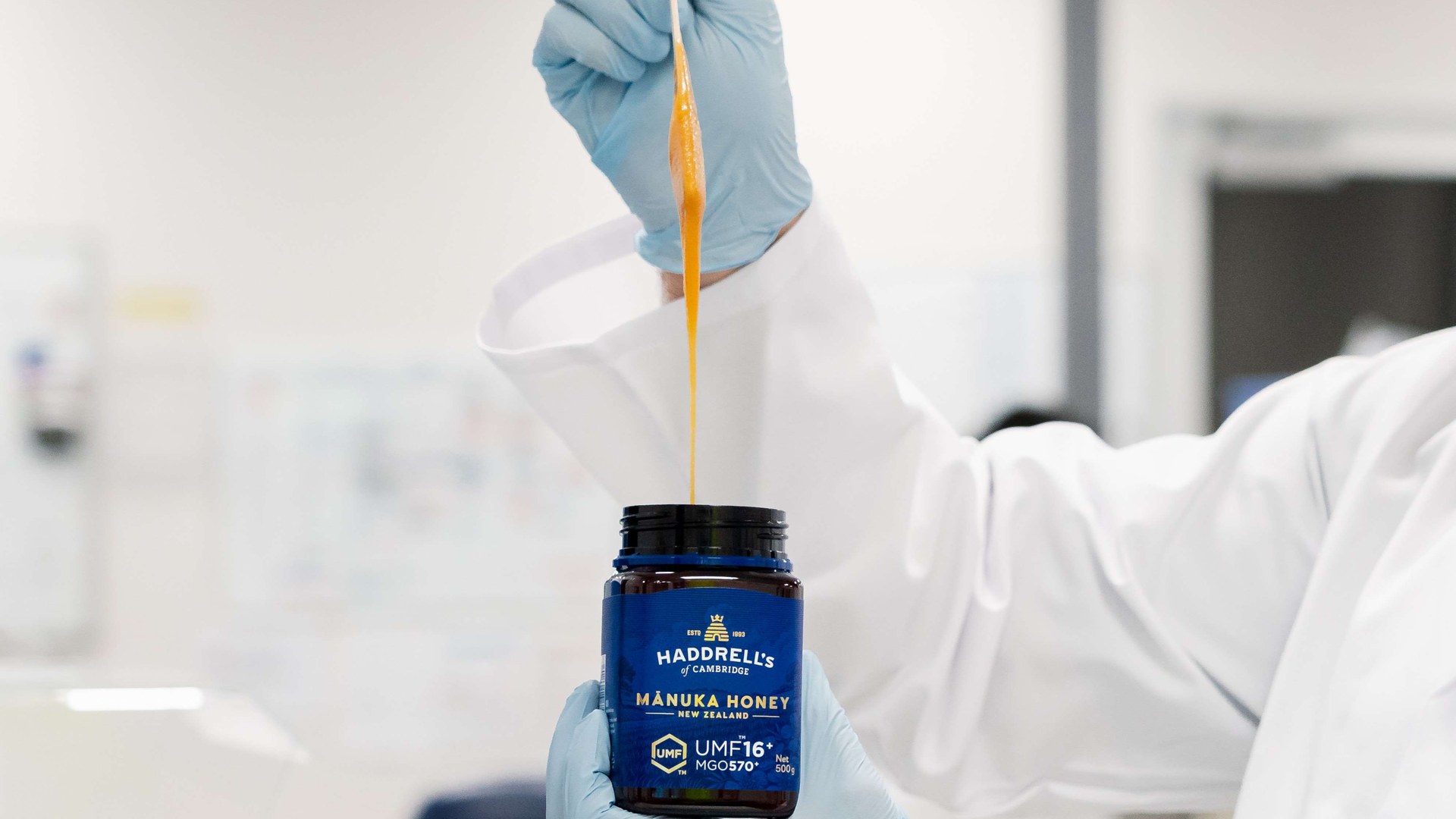
Ce que certifie réellement un « miel de Manuka certifié » — et comment vérifier un pot vous-même
Ce que certifie réellement un « miel de Manuka certifié » — et comment vérifier un pot vous-même
Le mot « certifié » travaille beaucoup sur les emballages de Manuka, et c'est l'un des termes les plus recherchés de toute la catégorie. C'est aussi l'un des plus flous, car un pot de Manuka peut être certifié pour au moins quatre choses différentes, qui ne prouvent pas du tout la même chose.
Voici toute la structure, du niveau le plus important au moins important — puis une vérification réalisable en boutique en moins d'une minute.
Niveau un : la certification d'exportation du gouvernement néo-zélandais
C'est le socle, et c'est celui que les acheteurs connaissent le moins.
Depuis 2018, aucun lot de miel ne peut quitter la Nouvelle-Zélande sous l'appellation Manuka sans satisfaire à la définition scientifique du ministère des Industries primaires. Ce test mesure quatre marqueurs chimiques et un marqueur ADN issu du pollen de Manuka. Le miel conforme est classé soit Manuka monofloral — majoritairement issu du nectar de Manuka — soit Manuka multifloral, une récolte authentique comportant davantage d'autres fleurs. Un miel non conforme ne peut pas être exporté comme Manuka.
Ce n'est pas une promesse de marque : c'est un résultat de laboratoire d'État attaché à une expédition, et c'est ce qui sépare un miel de Manuka d'un miel portant le mot Manuka.
Ce que cela prouve : le miel est bien du Manuka, et il vient bien de Nouvelle-Zélande. Ce que cela ne prouve pas : sa puissance.
Niveau deux : la licence UMF
UMF est un programme de certification géré par la UMF Honey Association ; un producteur doit être licencié pour utiliser la marque. Chaque lot est analysé pour quatre éléments :
- MGO — le composé signature, et le chiffre de puissance.
- DHA — le précurseur encore en cours de conversion en MGO, qui renseigne sur le vieillissement du miel.
- Leptospérine — un composé naturel du nectar de Manuka, extrêmement difficile à falsifier. C'est le contrôle d'authenticité.
- HMF — qui augmente avec l'âge et la chaleur : une valeur basse signifie un miel frais et non surtransformé.
Un véritable pot UMF porte un numéro de licence. C'est la partie que presque personne n'utilise — et c'est l'élément le plus utile de l'étiquette, car on peut le vérifier.
Ce que cela prouve : puissance, authenticité, fraîcheur et soin, vérifiés par un tiers. Ce que cela ne prouve pas : que le goût vous plaira.
Niveau trois : l'analyse de lot
Sous les programmes se trouve le modeste code de lot, généralement imprimé près de la date de durabilité.
Ce code relie votre pot précis à une récolte précise et analysée. Un producteur ou un revendeur sérieux peut vous communiquer les résultats de ce lot. Si personne ne le peut, la certification affichée en façade décrit la marque plutôt que le pot que vous tenez.
Ce que cela prouve : la traçabilité — que ce pot-ci, et non un pot semblable, a été analysé.
Niveau quatre : les certifications de régime et de production
Halal, casher, bio et marques similaires répondent à une tout autre question. Elles ne disent rien de la puissance ni de l'authenticité du Manuka : elles concernent la manière dont le miel a été produit, manipulé et supervisé. Si l'une d'elles compte pour vous, cherchez-la explicitement ; ne présumez pas qu'un niveau premium l'implique. Nous détenons les certifications halal et casher et les publions séparément précisément pour cette raison.
Ce que « certifié » ne vous dit jamais
- Rien sur la valeur. Un UMF 10+ certifié et un UMF 25+ certifié sont tous deux pleinement certifiés. La certification est un plancher, pas un classement.
- Rien sur le conditionneur. « Conditionné en Nouvelle-Zélande » et « Produit de Nouvelle-Zélande » valent mieux qu'un « conditionné en » ailleurs, mention qui peut figurer sur un miel expédié en vrac.
- Rien sur le goût. Aucun laboratoire ne mesure si une cuillerée vous plaira.
La vérification en cinq étapes, en moins d'une minute
1. Lisez la ligne d'origine. Cherchez Produit de Nouvelle-Zélande. Méfiez-vous d'un « conditionné en » sans pays d'origine.
2. Cherchez Manuka monofloral ou multifloral. Si aucun de ces mots n'apparaît sur le pot, demandez pourquoi.
3. Trouvez un système de notation nommé et un signe plus. UMF, MGO, NPA, IAA, MGS — et un +, qui signifie minimum garanti. Un chiffre nu, « Active » ou « jusqu'à » est une affirmation plus faible. Notre guide sur toutes les mentions du Manuka autres que l'UMF couvre le reste de l'alphabet.
4. Trouvez le numéro de licence UMF — et vérifiez-le. La UMF Honey Association publie la liste de ses licenciés. Deux minutes avec un téléphone suffisent. Un pot utilisant la marque UMF sans numéro de licence est le signal d'alarme le plus clair qui soit.
5. Trouvez le code de lot et la date de durabilité. Puis, si cela compte pour vous, demandez au vendeur le certificat d'analyse de ce lot. La façon dont un vendeur répond à cette question en dit long.
Signaux d'alerte qui justifient de passer son chemin
- La marque UMF sans numéro de licence.
- Un chiffre de notation sans système nommé — « Manuka 300 », « Manuka AA ».
- « Total Activity » ou « TA », qui gonfle le chiffre en incluant l'activité peroxydique ordinaire que possède tout miel.
- Un prix radicalement inférieur à tout ce qui est comparable au même niveau. Le Manuka certifié est cher parce que le miel est rare et que les analyses sont réelles.
- Aucun code de lot, ou un code que personne ne sait expliquer.
Ce que nous faisons
Chaque pot de notre gamme est noté en UMF, et nous publions l'équivalent MGO à côté afin que vous puissiez comparer avec n'importe quelle autre étiquette sans calcul. Le miel est du Haddrell's of Cambridge, produit et conditionné en Nouvelle-Zélande, et vendu en Europe avec son niveau, son origine et sa certification énoncés ouvertement plutôt que suggérés par des adjectifs.
Si vous souhaitez le détail derrière un pot précis, demandez-nous. Cette question devrait toujours avoir une réponse.
À retenir
« Certifié » n'est pas une seule chose. C'est un test d'État attestant qu'il s'agit bien de Manuka, une licence de programme indiquant la puissance et l'authenticité, un code de lot reliant l'affirmation à votre pot, et — séparément — des certifications de régime qui répondent à une tout autre question.
Apprenez à lire les quatre niveaux, consacrez deux minutes à vérifier un numéro de licence, et vous n'aurez plus jamais à croire l'avant de l'étiquette sur parole.